The Datacenter Stack: From Power and Water to AI Agents
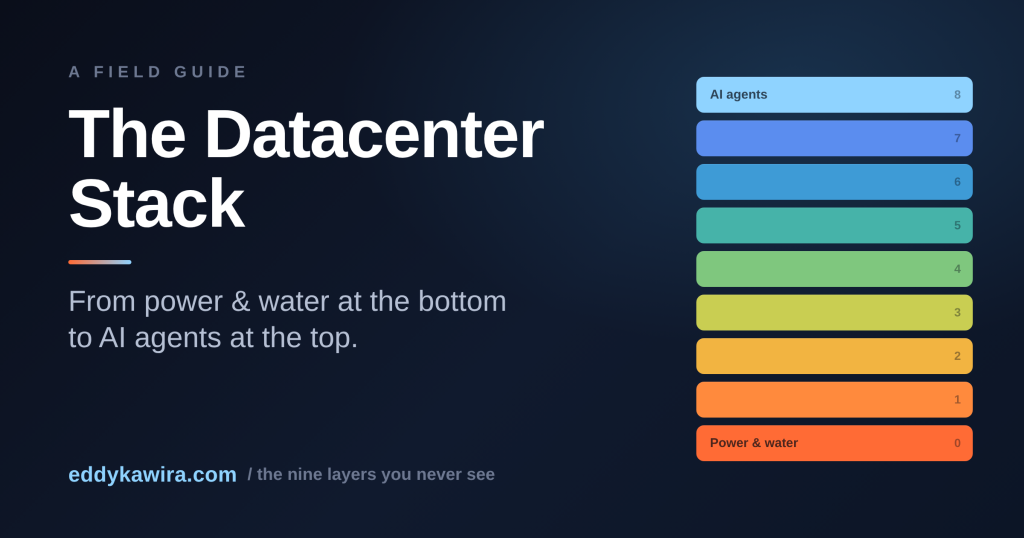
Table of Contents
A field guide to the layered stack you use a hundred times a day and never see — and why AI just made all of it everyone's problem.
TL;DR
- Everything you do online rides a tall stack — from utility power and chilled water at the very bottom, up through servers, fiber, and software, to the AI agents now sitting on top.
- Most of us only ever work one or two layers of it and treat the rest as someone else's problem. That used to be fine.
- The famous 7-layer OSI model you may have memorized is just one slice — the networking column — of this much taller stack.
- I didn't invent this view; a lot of people converged on it in 2026 (credit below). But if you've never seen the whole column at once, here's the map — with a name you'll recognize at each layer.
- And here's why it suddenly matters: AI collapsed the layers into a single problem.
You already use every layer — you just never see them
Open Netflix and hit play. Your tap travels down a stack — the app, an API, a database, the orchestration scheduling it, a hypervisor, the network (fiber, switches, DNS), and finally a physical server drawing power inside a cooled building — and the video streams back up, all in under a second. You experience exactly one row of that: the app. The other eight are invisible until one of them breaks.
Here's the reframe that makes it click: the 7-layer OSI model — physical, data link, network, transport, and so on — that some of us memorized for a networking class describes only networking. It's one vertical column. The real datacenter is a much taller stack, and OSI is a single slice through the middle of it.
(A note for the pedants — everyone else can skip this line: OSI is really a teaching model. What actually runs the internet is a leaner cousin called TCP/IP. But even engineers still talk in OSI's terms — "layer 3," "layer 7" — so it's the shared vocabulary worth borrowing here.)
I'd love to tell you I came up with this taller picture. I didn't. Jensen Huang popularized a "five-layer cake" version; Amit Patnaik wrote a nine-layer "electrons to tokens" version nearly identical to mine; and the "OSI-like model for infrastructure" idea goes back to at least Rob Hirschfeld's 2014 "7 Layer DIP." If you already work in this world, none of this is new. If you don't — that's exactly who this is for.
The map — with names you'll recognize
| Layer | What lives there | Who you'd recognize here |
|---|---|---|
| 0 · Facility physics | Utility power, backup generators, chilled water & cooling | Schneider Electric, Vertiv, Caterpillar (generators), your electric utility |
| 1 · Hardware | Racks, servers, AI accelerators, network cards | NVIDIA & AMD (GPUs), Google TPU (custom AI silicon), Dell & Supermicro (servers) |
| 2 · Network | Fiber, switches, routing, DNS | Corning (fiber), Cisco & Arista (switches), Cloudflare (DNS) |
| 3 · Compute abstraction | Hypervisors, containers, storage pools | VMware, Docker |
| 4 · Orchestration / IaC | Scheduling, infrastructure-as-code, CI/CD | Kubernetes, Terraform (HashiCorp), GitHub Actions |
| 5 · Data / state | Databases, caches, message queues | Oracle & PostgreSQL, Redis, Snowflake, Kafka |
| 6 · Services / middleware | APIs, microservices | Stripe (payments), Twilio (messaging) |
| 7 · Application | The apps you actually open | Netflix, Uber, Spotify |
| 8 · Agent / intelligence | AI agents orchestrating everything below | ChatGPT, Claude, GitHub Copilot |
Three honest caveats. First, the whole 7-layer OSI model you learned lives inside one row here — Layer 2. Second, putting Netflix at the application layer doesn't mean Netflix only lives there; big companies span the entire stack — it's just the layer where you experience them. Third, every name here is a well-known, publicly documented example of a company that operates at that layer — an illustration of the terrain, not any particular datacenter's supplier list. The names are anchors, not boundaries.
One fun aside for the network crowd (skip if it's not your thing): "Layer 8" has long been engineer slang for the human in the loop — the user, the org, the office politics; "that's a Layer 8 problem" is a polite way to say human error. So putting AI agents at Layer 8 — finally automating the layer that used to mean "the person" — feels about right.
Every layer lies to the one above it
Here's the load-bearing idea. Every layer survives by pretending the layer below it is infinite and reliable. Netflix's app pretends compute is limitless. The server pretends power and cooling simply exist and never run out. That pretense — the abstraction — is the only reason anyone can build anything; if the person writing an app had to reason about transformer capacity, nothing would ever ship.
But the pretense is a polite fiction, and it leaks. The interesting failures — the 3 a.m. outages — almost always live at the seams, where a lower layer's physical reality punches up through the abstraction above it. A cooling failure at Layer 0 becomes a slow app at Layer 7. This has a name: Joel Spolsky's Law of Leaky Abstractions — all non-trivial abstractions leak — recently stretched to cover AI too.
Why this suddenly matters: AI collapsed the stack
For decades those layers stayed politely separated. An app developer never once thought about water; a facilities engineer never thought about software. Everyone worked their row and ignored the rest.
AI broke that. Training and inference are so power- and thermally hungry that the top of the stack is now directly constrained by the bottom — the electrical grid is the ceiling now, not the software. It's why data centers are being built next to power plants, and why "how many megawatts can you get" became an AI-strategy question. The whole column started moving together.
Why so many of us drew this map at once
Which is the one thing I'll actually claim as mine: the convergence is the signal. A dozen people independently reached for the same layered picture in the same twelve months — not because we're unoriginal, but because the terrain changed and a layered map is what the mind reaches for when a system that used to be modular suddenly isn't.
When a bunch of independent people invent the same tool at once, stop asking who was first. Ask what changed in the world to make everyone need it.
What to do with this
If you take one thing from the map, take this: find your layer, then learn the two seams that touch it — the layer below that you depend on, and the layer above that depends on you. When something breaks in a way that makes no sense, it's usually a leak from an adjacent layer, not a bug in yours.
And notice that every layer has its own version of the same trap: a finite budget it pretends is infinite. For an app it's compute. For a datacenter it's watts and cooling. For an AI agent it's the context window — which is why less context often beats more, and why squeezing more out of the same token budget is worth the effort. Same discipline, every layer: respect the budget of the layer below you, because it does not respect your optimism.
Work one end of this stack and never think about the other? That's the normal case — and increasingly the expensive one. If this map put a name to something you use every day, tell me which layer surprised you.
Table of Contents

About Eddy Kawira
Infrastructure Engineer & AI Systems Architect with 20+ years across IT systems, data center operations, and cloud architecture. Experience ranges from high-scale AWS data center deployments (Trainium2) and enterprise Azure Virtual Desktop migrations to building open-source AI agent tooling (ClawHub) used by 10,000+ developers. Runs a battle-tested hybrid Proxmox VE and Hyper-V homelab focused on reliability, deep observability, and safe automation.
View all posts by Eddy Kawira →